
 Member Portal
By Matthew Avenatti, Gunsite Instructor
One of the more important aspects of defensive handgun shooting in my opinion, is the proper application of the presentation. When executed properly, the control exerted over the firearm sets you up for success. That success as usual, requires some work.
For those unfamiliar with the terminology, the presentation is the process of bringing the pistol from the holster to alignment with the target.
Just as the balanced fighting stance forms the foundation for the body during defensive actions, the initial grip obtained on the firearm during the presentation forms the foundation for a functional, effective grip. The question therein is how do we obtain it, be able to repeat it and do it within the time constraints of a defensive situation?
Let’s review quickly the five-step presentation taught at Gunsite. Sequentially, there is the initial grip (GRIP), clearing the holster (CLEAR), rotating the muzzle onto the target (ROTATE), smack- where the hands are brought together to form the overall shooting grip (SMACK) and the look- where the firearm is brought up to the line of sight and onto the target simultaneously (LOOK).
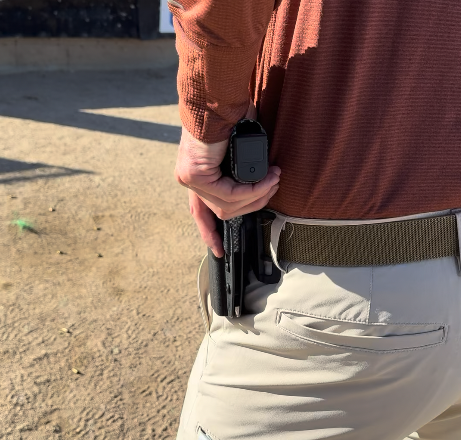
Now it’s time to get into it. Too many times, I see students take an initial slow, timid approach to placing their hand on the firearm when in the holster. You are training for the fight of your life, so start acting like it. The move to the firearm starts from whatever position your shooting hand may be in. It will likely be at your side or somewhere along the center line of your body in front of your torso. As you move the shooting hand towards the firearm, set it up like a jab. For those of you unfamiliar with the jab, it is a short quick blow with a closed fist. Once landed, it is immediately retracted to its original position. Unlike the cross or hook, punches which are meant to penetrate the opponent deeper or swing through the point of contact, the jab is a quick initial hit with immediate retraction. So how does this apply to the presentation?
I want to you jab your shooting hand onto the grip of your gun. This energy will force the gun and holster and likely your belt down slightly. This action will do several things. One, it is forcing your hand to position itself as high along the backstrap of the grip. The webbing between your thumb and trigger finger is forced as high as it will go into the curve at the top of the backstrap. This curve at the top of the grip serves two purposes. It keeps our hand below the reciprocating slide and serves as the fulcrum your gun wants to rotate around during shooting. Your gun after all is a simple machine, the lever. In fact, there are a bunch of levers in your gun, but that’s another article for another time. Secondly, as you jab at your gun, you are building kinetic energy in it, your holster and your belt. There is only one way for it to go after that and that is up and out. Essentially, you are bouncing it out of your holster.
How do we practice this? I suggest starting with your next dry practice session. With an unloaded firearm, in your holster, on your belt in your preferred carry position start with simply jabbing at your gun’s grip without clearing it from the holster. Ensure the hand and webbing between the thumb and shooting finger is as high as you can get it while still in the holster. Any holster worth its salt will allow you to do this. If not, rethink your holster choice. If you are utilizing a retention holster, these devices are deactivated at this time. Also, ensure you are building that kinetic energy in your gun, holster and belt to utilize when you will actually draw the firearm. The energy will be stored very temporarily in the compression of the tissue in the shooting hand, the flex of the leather or kydex holster and belt as well as the body tissue the belt sits on. As you wrap your ancillary finger around the grip, position your trigger finger along the holster so it is properly positioned high on the slide upon clearing. Once you become comfortable with this first step, move on clearing the firearm from the holster.
Remember, a jab is a quick hit with instant retraction. After you hit your grip and establish that proper grip (which at this point you are familiar with), perform an instant retraction or clearing of the firearm.
Re-holster (slowly and deliberately) from the clearing portion of the presentation and continue to practice the two initial steps. Proper repetition will thicken the myelin sheaths of the nerves required to perform this act, which is our ultimate goal. This embeds it into our unconscious thought and action process.
When I dry practice, I use the “Range Timer” app on my phone. I like it because it picks up the audible click of the trigger breaking (it takes some getting used to but very useful once dialed in). It is difficult to measure the time of the two initial steps of the presentation, but you will see a difference in your overall presentation time.
In my experience this one small change had the most impact on my presentation. It gave me control, efficiency and confidence. These will set you up for success so, take a jab at it.
About the Author
In addition to serving as a Gunsite Instructor, Matthew Avenatti is a law enforcement officer in northern New Jersey. He served 26 years with the New Jersey State Police and retired as a Lieutenant/ Station Commander. Matt served in several units spending the majority of his career in patrol. He spent many years on a criminal interdiction team focusing on commercial vehicles and was also a part of the firearms instructor cadre dealing in handgun, carbine, and shotgun training & techniques. Currently serving as an Undersheriff with his county Sheriff’s Office, Matt is still active in the firearms training arena teaching pistol and carbine classes.

About Gunsite
This article is provided by AWA’s .50 Caliber Sponsor, Gunsite Academy . Founded in 1976 by Lt. Col. Jeff Cooper, Gunsite is a 3200+ acre facility offering firearm training to civilians, law enforcement, and elite military personnel in handgun, carbine, precision rifle & defensive shotgun focusing principles of marksmanship, gun-handling and mindset, known as the Combat Triad. Each discipline is informed by the Combat Triad and each instructor at Gunsite is someone who has served in Law Enforcement, the military or both. Each Instructor is fully imbued with the doctrine, history and tradition of Gunsite.
